
If you want to invest in space tourism, the first thing to establish is how big the market actually is – and
honestly, nobody agrees. For 2026 alone, published estimates range from
roughly US$1.5 billion (Mordor Intelligence) to US$1.9 billion (Grand View Research) to US$8.9 billion
(Future Market Insights) – a six-fold spread between reputable analysts for the same year. Longer-range forecasts
diverge even further, from US$3.2 billion by 2031 to US$62 billion by 2036.
That spread is itself the most useful piece of information an investor can have about this sector. It tells you the
market is small enough today that definitions matter enormously – whether you count stratospheric balloon rides,
whether you count chartered orbital research missions, whether you count the launch services underneath them.
So how investable is it? Space Tourism is a real industry with real customers, real flight hardware and serious
long-term backers. But as of August 2026 it is also an industry in the middle of a difficult transition, and the
honest picture is more complicated than the headlines from 2021 suggested.
Space Tourism as an Investment remains
a difficult question, because there is still no true pure-play space tourism stock. Virgin Galactic (NYSE: SPCE) is the
closest listed equivalent and remains pre-revenue. SpaceX listed on Nasdaq in June 2026 under the ticker SPCX, but
tourism is a rounding error next to its launch and Starlink businesses. Most exposure to this theme still comes through
private companies, or through diversified space and aerospace equities.
In time, as demand expands and the cost per trip falls, the process of launching from a spaceport, experiencing zero
gravity and seeing Earth from space should become routine. That has not happened yet. Prices have gone up, not down.
This is the single most important fact for anyone assessing the sector right now, and it is not widely understood.
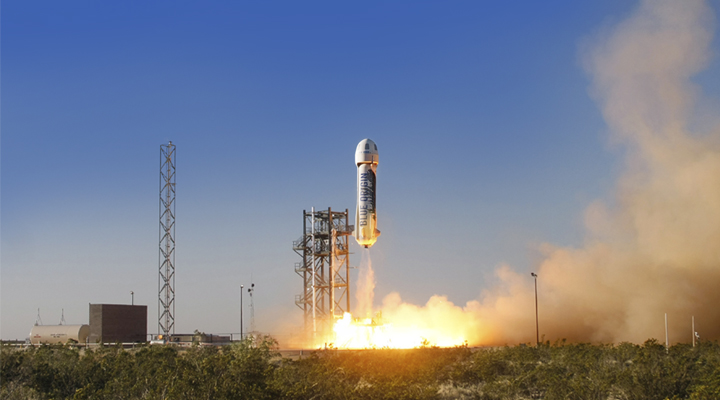
On 30 January 2026, Blue Origin announced it would pause New Shepard flights for no less than two years, shifting
resources to its Blue Moon lunar lander and the NASA Artemis programme. Its final tourist flight, NS-38, flew on
22 January 2026. Over its career New Shepard flew 38 times and carried 98 people above the Kármán line.
The company says it retains a multi-year customer backlog but has not said how existing reservations will be handled.
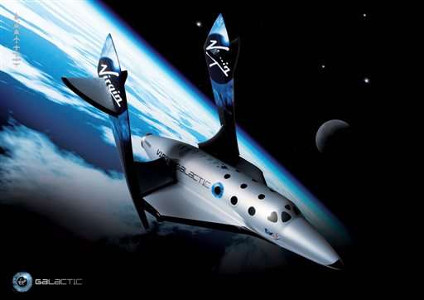
Virgin Galactic has not flown a paying customer since June 2024, when VSS Unity was retired to make way for the
Delta-class fleet. Delta flight testing is targeted for Q3 2026 and first spaceflight for Q4 2026, with commercial
operations ramping through 2027.
Twenty-two years after SpaceShipOne won the Ansari X Prize, the two operators that defined sub-orbital tourism are
currently flying zero tourists between them. One is on a planned hiatus; the other is mid-rebuild.
Space tourism companies still require capital, and the underlying thesis – that high net worth individuals will
pay for a safe, repeatable experience of space – has not been disproved. Several thousand people have now paid
deposits.
But the 2026 pause is a reminder that sub-orbital tourism has struggled to prove it should exist as a standalone
business, rather than merely that it can. Blue Origin, the company that has flown more space tourists than anyone in
history, looked at its own numbers and redirected the engineering effort elsewhere.
Meanwhile the centre of gravity has shifted. Orbital private astronaut missions, commercial space stations and
stratospheric balloon flights are all now credible parts of the same market – and in some cases better funded
than the rocket-powered joyride.
If you would like to know more about investing in a space tourism company, then get in contact with Space Ventures
Investors.
European Space Ventures AG is developing the European Space Bond with selected partners, with the aim of launching Europe's first commercial space bond in Q4 2026. The bond answers clear investor demand and will allocate capital predominantly to European space companies — from start-ups through to selected space equities that fulfil specific technological specifications. Europe has a disciplined culture of innovation but has to date lacked a vibrant financial funding mechanism to match it. The European Space Bond is designed to be that solution.
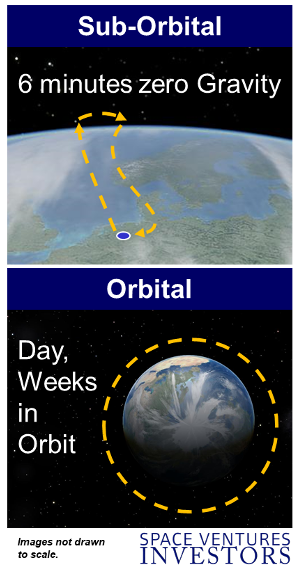
A short flight above the Kármán line (100 km) or the US-recognised 80 km boundary, offering
a few minutes of weightlessness before returning. The whole experience lasts around ten to ninety minutes.
Prices have risen, not fallen. Virgin Galactic reopened sales in April 2026 at US$750,000 per seat, up from the
previous US$600,000. Blue Origin never published a list price; seats were secured with a US$150,000 refundable deposit,
and one auctioned seat reached US$28 million.
Current operators and their status:
Actually orbiting Earth, at roughly 28,000 km/h, for days or weeks rather than minutes. Far more expensive and
far more capable – but as of 2026 this is the part of the market that is actually flying people.
If sub-orbital tourism is a joyride up and down, then orbital tourism is a stay in a space hotel. Seats run
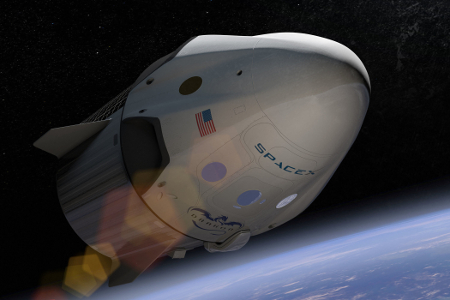
approximately US$55 million via Axiom Space, whose missions use SpaceX Crew Dragon to reach the International
Space Station.
The "space hotel" itself is now under construction rather than merely proposed. With the ISS due to be retired around
2030, NASA's Commercial LEO Destinations programme is funding privately operated successors, with Phase 2 awards to at
least two providers expected during 2026.
Multi-billion dollar finance is routinely raised for leisure projects like cruise ships, and falling launch costs mean
more capacity to loft pre-fabricated modules into a stable orbit.
A third category that did not meaningfully exist when this page was first written. Pressurised capsules are lifted by
helium or hydrogen balloons to between 25 and 35 km over a gentle six-hour flight.
These flights do not reach space by any recognised definition, and there is no weightlessness. What passengers
get is the curvature of the Earth against a black sky, with no g-forces, no training requirement and no medical
screening – and at a materially lower price point, from around US$50,000 to US$180,000.
It is a genuinely different business model with different risks. It is also the segment where several ventures have
already run out of money.
Which companies are actually focussed on space tourism?
The companies below are developing the vehicles, habitats and operations needed to carry paying passengers. Many others
supply the technology underneath them without ever selling a ticket.
For more information on listed space and aerospace companies, visit
Space Stocks.




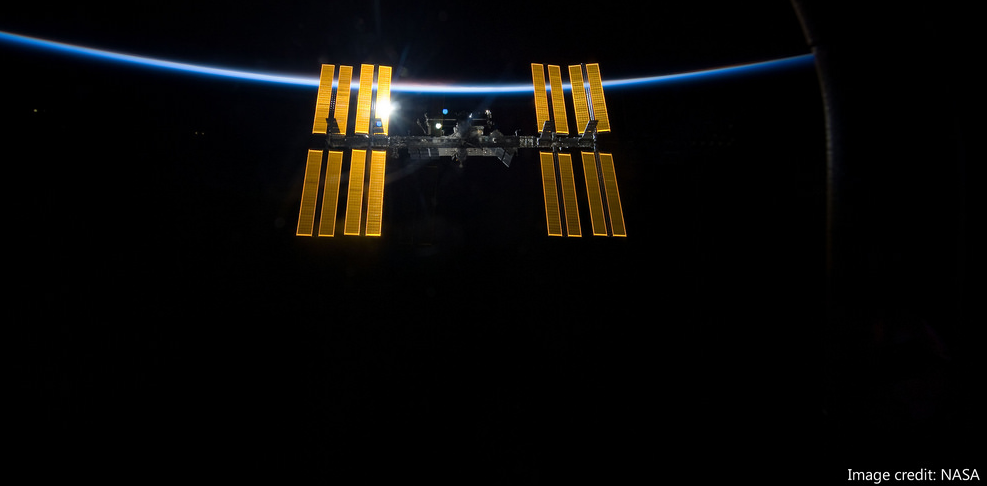
The ISS is due to be retired around 2030. NASA's Commercial LEO Destinations programme is funding privately operated successors, and a strategy revision announced in March 2026 – known as Ignition – may see private developers supply modules to a government-anchored hub rather than each building fully independent free-flying stations. Phase 2 awards to at least two providers are expected during 2026. These stations are where orbital space tourism will actually happen.
Vast – Founded in 2021 by Jed McCaleb and
privately funded, Vast is building Haven-1, intended to be the world's first standalone commercial space
station. It is a single module of roughly 45 m³ – about the interior volume of a small tour bus –
designed to host four crew for stays of around ten days across a three-year orbital life, launched on a Falcon 9.
Originally targeted for May 2026, the launch was pushed in January 2026 to no earlier than Q1 2027. In February
2026 Vast won a NASA private astronaut mission, the first ever awarded to a company other than Axiom. Its longer-term
Haven-2 concept is a nine-module ISS successor.
Starlab – A joint venture of Voyager
Technologies, Airbus, Mitsubishi and MDA Space. Roughly 340 m³, designed to reach orbit in a single Starship
launch, targeted around 2028.
Orbital Reef – Blue Origin and
Sierra Space, with Boeing and Redwire, describe it as a mixed-use business park in orbit, designed for around
830 m³ at full build and ten occupants. Originally projected to be operational by 2027; that timeline has
slipped substantially and the station remains in development.
Space Adventures – The original space tourism
broker, established in 1998. It arranged the first ever space tourist flight, Dennis Tito's ISS trip in 2001, and
seven subsequent orbital missions via Russian Soyuz, the last carrying Yusaku Maezawa in December 2021. The company
still markets spaceflight experiences, but its Soyuz-to-ISS programme has been dormant since 2021 and it is not
currently taking orbital bookings.
A note on a company previously listed on this page: Bigelow Aerospace, once the leading developer of
expandable orbital habitats, laid off its entire workforce in March 2020 and suspended operations in 2021. It is now
defunct. Sierra Space acquired the expandable habitat technology rights and is developing its LIFE module.
Balloon-borne capsules do not reach space, but they are marketed and sold within the same category, at a fraction of the price, with no training or medical requirements. The technology is well proven from decades of scientific ballooning. The business model is not – this segment has seen the sector's most visible financial failures.
Space Perspective / Eos X Space – A
cautionary tale worth understanding. Space Perspective developed the Spaceship Neptune capsule and flew an uncrewed
test to roughly 30 km in September 2024, selling seats at US$125,000. It then ran short of cash, furloughed almost
its entire workforce in January 2025 and was evicted from its Florida airport facilities that April.
Spanish company Eos X Space acquired it in July 2025. Critically, the acquiring entity did not assume the prior
company's debts, customer contracts or reservations. Eos X plans facilities at Kennedy Space Center and in Silicon
Valley.
Zephalto (France) – The Céleste capsule,
ascending to around 25 km, priced between roughly €120,000 and €180,000, and supported by the French
civil aviation authority. Zephalto is the only operator in this segment to have conducted crewed test flights, though
not yet at target altitude. Commercial flights are now expected from 2027.
Halo Space (Spain / Saudi Arabia) – The
Aurora capsule, targeting around 35 km on flights of up to six hours, at approximately US$160,000. Five test
flights completed, beginning in Hyderabad in December 2022 and continuing in the Mojave Desert. Halo previously
advertised commercial operations from 2026; its chief executive now describes a target of 2029.
World View (Arizona) – The cheapest ticket in the
sector at around US$50,000, carrying eight passengers and two crew to roughly 30 km from spaceports sited at
landmarks including the Grand Canyon. More than 1,250 reservations taken, but commercial service has slipped
repeatedly from an original 2024 target.
Also previously listed on this page: Zero 2 Infinity (Barcelona) still trades, but has refocused on its
Bloostar small satellite launcher. Its Bloon tourism capsule has been dormant since target dates of 2021 passed.
The most significant new entrant since this page was last revised. Chinese commercial space companies are developing
sub-orbital tourism vehicles on timelines that would place them in service while Western operators are still returning
to flight.
Deep Blue Aerospace – Based in Jiangsu
province and founded in 2016, Deep Blue is developing a reusable single-stage rocket and crew capsule closely
comparable to New Shepard. The system is designed to fly to between 100 and 150 km, carrying six passengers with
six windows, for a flight of roughly twelve minutes including several minutes of microgravity. The capsule is designed
for 50 reuses.
Tickets are priced at 1.5 million yuan, approximately US$210,000, with a 50,000 yuan deposit. The first two were
sold during a Taobao livestream in October 2024. Commercialisation is targeted for 2027, contingent on progress with
the company's Nebula-1 reusable rocket.
CAS Space, a spin-off from the Chinese Academy of Sciences, is developing a crewed sub-orbital vehicle of its
own, with flights indicated from around 2027 to 2028.
For investors, Chinese ventures are largely inaccessible directly, but their pricing will shape the global market. A
US$210,000 Chinese ticket sits well below Virgin Galactic's US$750,000.
Since 2009
Space Ventures Investors
has been researching how small and large investors can invest in the next space race. As the space business has grown, so have the options for investing in space.
If you’re interested in investing in space resources, we offer one investment that covers the full spectrum of space resources related companies.


Space Ventures Investors
is focussed on bridging space investors with space investments.
If you are interested in investing in space, then get in contact with us.

Space Ventures Investors - Our main website and corporate home.
European Space Ventures - Formed in 2025 to be a key space investing choice for European space investors.
Space Resources - Find out about investing in Space Resources Companies.
Lunar Resources Registry
- Lunar Mining is possible, thanks to registering locations for exploration and extraction.
Space Stocks and Space Funds - A research platform for space stocks and space funds, including share price charts and analysis.
Space Ventures Investors
is only focussed on bridging space investors with space investments.
We value your data and your feedback.
